We've tested Chicken Road across several sessions at partner casinos to evaluate its mechanics, payout structure, and overall fairness. In this review, we'll break down how the game works, what you can realistically win, and whether InOut Games has delivered a crossing mini-game that holds up under scrutiny. As always, remember that mini-games are designed with a house edge—responsible gambling and a clear budget remain essential.
Chicken Road: key facts
| Provider | InOut Games |
|---|---|
| Type | Crash / Instant Win Game |
| RTP | Not disclosed by provider |
| Volatility | High (player-controlled risk) |
| Min / max bet | Varies by casino (typically £0.10–£100) |
| Max win | 20,000× stake |
| Mobile | Yes (HTML5, all devices) |
| Demo | Yes |
A polished crossing mini-game with genuine tension and a spectacular max win, though the lack of published RTP and limited strategic depth may deter some players.
What is Chicken Road?
Chicken Road belongs to the 'crash' or 'instant win' family of casino mini-games, a category that strips away the bells and whistles of video slots in favour of straightforward risk-and-reward mechanics. You pilot a cartoon chicken across a multi-lane road; each successful crossing to the next lane increases your active multiplier. The catch: vehicles travel horizontally across each lane at random intervals, and if your chicken collides with one, the round ends and your stake is lost. You can cash out at any moment to lock in your current multiplier, or push forward in pursuit of higher returns.
InOut Games frames the experience with bright, lighthearted visuals—think mobile-friendly graphics with cheerful sound effects—but beneath the approachable exterior lies a high-volatility game built around player decision-making. Unlike a slot where outcomes are entirely predetermined, Chicken Road puts you in the driver's seat (or rather, the chicken's feet): every hop forward is a conscious choice to multiply your bet or gamble it away. The 20,000× maximum win is theoretically within reach, though in practice you'll need both nerve and luck to navigate enough lanes to approach that figure.
The game runs on HTML5, so it adapts seamlessly to desktop, tablet, and mobile browsers without requiring a download. Sessions are quick—most rounds resolve in under a minute—which suits players looking for fast-paced action between longer slot sessions or those who prefer mini-games as a primary format.
How to Play Chicken Road
1: Set Your Stake and Observe the Road
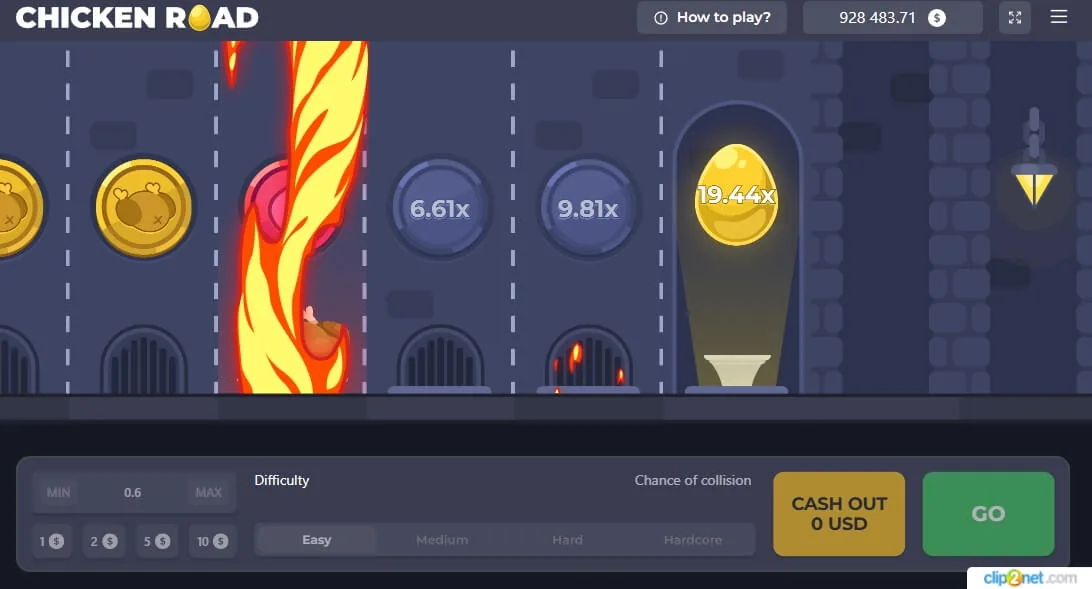
Before each round, select your bet size using the controls at the bottom of the screen. The interface typically displays your balance, current stake, and potential win in real time. Once you've confirmed your wager, the game presents a grid of lanes stretching vertically up the screen, with your chicken positioned at the starting line. Vehicles—cars, lorries, and other obstacles—begin scrolling horizontally across each lane at varying speeds. Take a moment to watch the traffic patterns: while the timing is randomised, observing the density and rhythm of each lane can help you gauge the immediate risk before committing to a move.
2: Advance Lane by Lane, Building Your Multiplier
Press the 'hop' or 'next' button to move your chicken forward onto the first lane. If the chicken clears the lane without hitting a vehicle, your multiplier increases—usually starting at 1.1× or similar and climbing incrementally with each successful crossing. The multiplier is applied to your original stake, so a £10 bet at 2× returns £20, and so on. You can continue hopping forward as long as you dare, with each lane representing a fresh dice roll: the game generates collision outcomes in real time (or uses a provably fair algorithm, depending on the casino's implementation). The further you go, the higher the multiplier—but also the greater the cumulative risk of a collision ending your run.
3: Cash Out Before a Collision Ends the Round
At any point before hopping to the next lane, you can press 'cash out' to collect your winnings based on the current multiplier. Timing is everything: cashing out too early leaves potential winnings on the table, while pushing too far often results in a collision and total loss of the stake. Once you cash out or collide, the round concludes and you return to the betting screen to start afresh. There's no auto-play in the traditional sense—each hop requires manual input—which keeps you actively engaged but also means longer sessions demand sustained concentration.
How Much Can You Win on Chicken Road?
InOut Games lists a maximum win of 20,000× your stake, which translates to £200,000 on a £10 bet or £20,000 on a £1 wager. Reaching that ceiling requires successfully crossing enough lanes to build the multiplier to four or five figures—a feat that becomes exponentially harder as you progress, since each additional lane introduces another collision opportunity. In practice, most players will see their best results in the 5× to 50× range during regular play, with occasional runs pushing into triple digits if luck and timing align.
Because Chicken Road is a high-volatility game, payouts cluster at the extremes: you'll experience frequent small losses (early collisions) punctuated by occasional medium-to-large wins when you manage a sustained run. The lack of a published RTP figure is a notable gap—InOut Games does not disclose a return-to-player percentage on their public spec sheet, which means players must trust the operator's certification and any third-party audits. Reputable online casinos typically display RTP data in the game's information panel; if it's absent, consider that a red flag.
- Maximum win: 20,000× stake (£200,000 on a £10 bet).
- Typical successful runs: 5× to 50× in normal sessions.
- High volatility: expect long dry spells broken by occasional larger payouts.
- No published RTP from provider—check casino certification and fairness seals.
- Multiplier growth is incremental; reaching four-figure multipliers demands dozens of successful hops.

Strategies and Good Habits for Chicken Road
Set a Target Multiplier and Stick to It
Because every hop is a manual decision, Chicken Road lends itself to discipline-based strategies. Before each round, decide on a target multiplier—say, 3× or 5×—and cash out the moment you reach it, regardless of temptation to push further. This approach won't change the house edge, but it does impose structure on an otherwise emotion-driven game. Players who chase the 20,000× max win will almost always collide before reaching it; a modest, repeatable target keeps variance in check and extends your session bankroll.
Watch Traffic Density, Not Individual Vehicles
While Chicken Road's vehicle timing is randomised, lanes often differ in traffic density: some may have fewer obstacles, others a nearly constant stream. Instead of trying to time individual cars—a futile exercise given the randomness—focus on identifying which lanes appear less congested over a few rounds. If a particular lane consistently shows heavy traffic, consider cashing out just before it rather than gambling on a narrow gap. This won't guarantee success, but it can marginally reduce the frequency of early collisions.
Separate Your Bankroll into Fixed-Stake Sessions
High-volatility games chew through bankrolls quickly if you don't impose limits. Divide your total budget into fixed-stake sessions—for example, 20 rounds at £5 each—and walk away once that allocation is spent, win or lose. Avoid the trap of chasing losses by increasing your bet size after a collision; Chicken Road's outcomes are independent, and raising stakes in frustration only accelerates losses. If you hit a significant win early, consider pocketing half and playing with the remainder to guarantee a net-positive session.
Free Demo or Real Money?
Chicken Road is widely available in demo mode at partner casinos, allowing you to test the mechanics and volatility without risking your own funds. The demo uses virtual credits that reset automatically, so you can experiment with different cashing-out thresholds and observe how the multiplier scales over multiple lanes. We strongly recommend several demo sessions before committing real money—crash games feel deceptively simple, but the psychological pressure of watching your multiplier climb while traffic whizzes past is markedly different when actual stakes are on the line.
That said, demo mode has limitations: you won't experience the genuine tension (or elation) of a real-money run, and some casinos apply a subtle 'demo luck' effect where early sessions yield better results to hook players. Treat demo wins as a learning tool, not a predictor of real-money performance. Once you're comfortable with the controls and pacing, switch to real money with a modest stake you can afford to lose. Chicken Road's quick rounds make it easy to burn through a budget in minutes, so err on the side of smaller bets until you've calibrated your risk tolerance.
Our Opinion on Chicken Road
Chicken Road succeeds where many crash games stumble: it delivers genuine tension without relying on gimmicks or convoluted rule sets. The core loop—hop, assess, cash out or continue—is elegant, and InOut Games has polished the presentation to a high sheen. The cartoon aesthetic won't appeal to everyone, but it keeps the mood light even during losing streaks, which matters when volatility runs high. The 20,000× max win is impressive on paper and theoretically attainable, though reaching even a fraction of that ceiling demands both patience and luck.
The game's Achilles' heel is transparency. InOut Games does not publish an RTP figure, which leaves players guessing whether the house edge is a reasonable 3–4% or a punishing 10%. Provably fair implementations can mitigate this concern at crypto casinos, but traditional operators rarely disclose enough detail to verify fairness independently. We also found the lack of customisation options—no auto-cashout thresholds, no adjustable lane counts—slightly limiting; competitors like Turbo Games' Crasher X offer more granular control for experienced players. Still, for a crossing mini-game, Chicken Road strikes a solid balance between accessibility and depth.
👍 Pros
- Polished visuals and responsive controls across desktop and mobile.
- Spectacular 20,000× max win creates genuine big-win potential.
- Player-controlled pacing: every decision matters, no passive spinning.
- Quick rounds suit short sessions or breaks between longer games.
- Demo mode widely available for risk-free practice.
👎 Cons
- No published RTP—transparency gap undermines trust.
- High volatility leads to frequent total losses; bankroll drains quickly.
- Limited strategic depth: beyond target multipliers, little room for skill.
- No auto-cashout or advanced settings for experienced players.
Frequently asked questions
Is Chicken Road provably fair?
That depends on the casino. Some operators implement provably fair algorithms that let you verify each round's outcome via a cryptographic hash; others rely on standard RNG certification from bodies like eCOGRA or iTech Labs. Check the game's information panel or the casino's fairness page—if neither mentions third-party audits or provably fair mechanics, proceed with caution.
What is the RTP of Chicken Road?
InOut Games has not published an RTP figure for Chicken Road. Reputable casinos sometimes display RTP in the game's paytable or help section; if it's absent, the return-to-player percentage remains unknown. Industry-standard crash games typically sit between 96% and 99%, but without official data, we cannot confirm where Chicken Road falls.
Can you win £200,000 on Chicken Road?
Theoretically, yes: the 20,000× max win allows for a £200,000 payout on a £10 stake. In practice, reaching that multiplier requires crossing dozens of lanes without a single collision, an event so statistically rare that most players will never approach it. Treat the max win as a ceiling, not a realistic target.
How volatile is Chicken Road compared to slots?
Chicken Road is high volatility, similar to slots rated 9 or 10 out of 10. You'll see frequent small losses punctuated by occasional larger wins. Unlike slots, where volatility is baked into the paytable, Chicken Road's variance is partly player-controlled—you choose how far to push each round—but the underlying collision probability ensures long-term losses for the majority of players.
Should I play Chicken Road in demo or real money first?
Always start with demo mode. Chicken Road's mechanics are simple, but the psychological pressure of manual decision-making under rising stakes is hard to simulate without practice. Spend at least 50 demo rounds experimenting with different cash-out thresholds before risking real money, and begin with the minimum bet once you switch to live play.